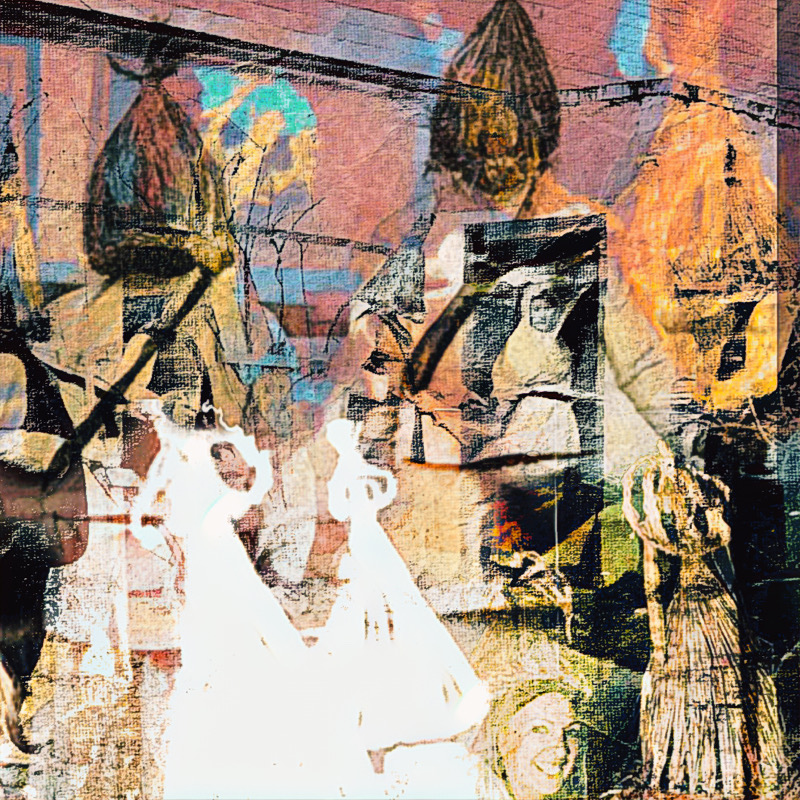
The Strawboys were small bands of disguised men, who traditionally arrived as uninvited guests to weddings in most of Ireland. Their disguises varied, but always included straw and often women’s clothing. They were particularly focused on anonymity, wearing hats or masks that covered their faces and often obscured their height. Otherwise known as Buachaillí tuí, Cleithíni, Cailleachs, Fools, Grannies, Cleamairí, Banbeggars, Falcairí and countless other names, these revellers were either welcomed, feared or despised, depending on the account, but it was certainly considered good luck to provide them hospitality and poor luck to refuse them (Ó Danachair, 1985; O’Dowd, 2022).
Strawboys, with a distinct captain, arrived to a wedding celebration either after the ceremony or after the honeymoon. Their disruption prompted dancing and usually an expectation of food, drink or money. Some accounts refer to damage and havoc caused by revellers, who are rebuffed (Ó Danachair, 1985; O’Dowd, 2022). The wedding celebration is a liminal stage for all in attendance, with the rite of separation being the removal of the bride from her family and the rite of incorporation being a return to normalcy with a change in status from single to married after the celebration or honeymoon. The ritual of the Strawboys adds another layer of liminality to the celebration. They arrive at night in complete anonymity, wearing stolen straw and dressed in the clothing of a different gender.
Communitas is observed as the bride and other guests dance with the interlopers, providing them with drink in exchange for their well-wishes. In some instances, the Buachaillí tuí would remove their costumes and join in the celebration as community members, occasionally burning their costumes in a bonfire, though in most cases they would leave. These actions serve to incorporate the couple into the community (Ballard, 1998; O’Dowd, 2022). The Strawboy tradition likely has some origins in licenced begging and was greatly suppressed by civic authorities in the 1930s and 40s, but persisted in some areas for another thirty years (O’Dowd, 2022). Rarely, couples today still welcome this “representation of the human life-cycle that must originally have been enacted to promote the well-being of the community at large” (Gailey, 1969, cited in O’Dowd, 2022).
Reference List
Ballard, L.M. (1998) ‘Celebration, prank and disruption’, in Forgetting frolic: marriage traditions in Ireland. London: Belfast: Institute of Irish Studies, the Queen’s University of Belfast, pp. 105–126.
Ó Danachair, C. (1985) ‘Marriage in Folk Tradition’, in A. Cosgrove (ed.) Marriage in Ireland. Dublin: College Press, pp. 99–115.
O’Dowd, A. (2022) ‘Folk drama, masking and straw’, in Straw, hay & rushes in Irish folk tradition. Kildare, Ireland: Irish Academic Press, pp. 80–133.
 Bridging Appalachia
Leave a comment