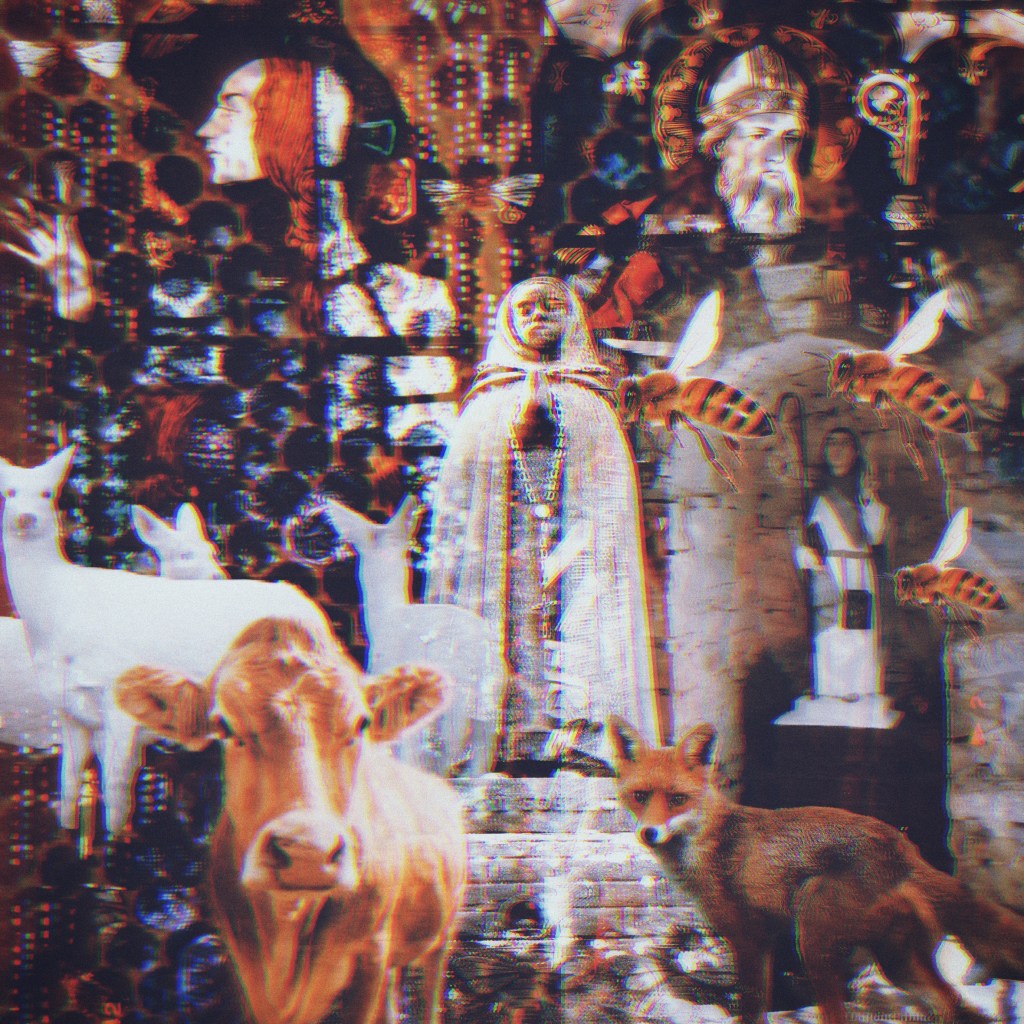
Irish popular religion exists as a vernacular reaction to both relationship with the natural world and community-based negotiations around institutional religion. It allows for the simultaneous existence of multiple ideas, which are enacted through story and practice. Saint tales and legends in Irish folk narrative incorporate Bascom’s four functions of folklore – entertainment, education, validating culture and maintaining community values, but along with other apocryphal narratives, they also seek to bring the divine to everyday lived-experience (1965). In the words of folklorist, Séan Ó Súilleabháin, they are a way for the Irish to “put flesh on the bare bones of the Gospels” by reflecting the local landscape and imbuing holy figures with an amalgamation of vernacular and supernatural characteristics (2011, 23), including a distinctive “dovetailing of what is [folk religion] into what is Christian” (Hyde and Nisbet 1917, v). Irish popular religion narratives of Saint Gobnait and Saint Ciarán, reveal deep relationships with animals, which demonstrate revered personal attributes and tie the figures to the landscape. The legends also encourage community interaction with the environment by instilling physical landmarks with meaning and medicine.
Saint Gobnait, known as the patron saint of beekeepers and ironworkers, is closely associated with bees in a number of tales. Archival sources describe those who are able to work with bees as truthful, chaste, sweet and quiet – characteristics which uphold community values, particularly for women (NFC S 342: 116-120). Saint Ciarán of Clonmacnoise is known for relationships with many animals, including a fox who he successfully trained to carry messages between his tutor and himself (NFC S 749: 258). This interaction depicts both patience and cleverness, which are honoured traits. Beyond openly celebrated qualities, saints can also serve as archetypes of resistance for the oppressed, while maintaining a safe illusion of distance from daily life.
In his analysis of values reinforced by Irish religious narratives, Ó Héalaí notes severe punishment for unjust acts (1972). Animal tales involving Saint Gobnait and Saint Ciarán epitomise protective behaviours, which defend common people from patriarchal figures. In a tale from County Cork, a poor woman finds herself in arrears with her landlord and has her cows confiscated by the local bailiffs. The woman prays to Saint Gobnait, who appears and sets her bees upon the dispossessors. Before the woman can thank her, she disappears (NFC S 342: 116-120). This narrative demonstrates, not only Saint Gobnait’s compassion and humbleness, but her capacity for retribution in the name of the people. In a tale of Saint Ciarán, a king throws a rock at the saint’s beloved cow and Ciarán curses him, saying he will die of thirst. The king reroutes the river Shannon to his castle, but still becomes ill and wastes away (NFC S 273: 388). Saint Ciarán’s defence of the cow proves both his kindliness and his recognition of the cow as a means of income and sustenance, which is integral to the common people. His reciprocal relationship with nature contrasts with that of the king, who is unable to quench his thirst by attempting to control the Shannon. Both of these tales serve as symbols of resistance and protection of community.
Through their actions, Saints Gobnait and Ciarán paint the Irish landscape with story. Saint Gobnait, sometimes said to be the daughter of a pirate, lived a questionable life before receiving a vision of nine white deer. Finding these animals, who are associated with the Otherworld by their colour and magic number, would indicate Gobnait’s resurrection as a servant of the Christian God (NFC S 342: 116-120). Her journey to find the deer can be traced across Ireland by both landmarks and rituals. In Waterford, Saint Gobnait is honoured by the parish of Killgobnait and as she passed through Limerick, she blessed a pagan well with her name. Near her passage through the village of Bealathgreen, a fair occurs on the 11th of February, known as the feast day of Saint Gobnait. Pilgrims perform rounds, travelling deiseal around the sacred space in ritual action. Close by, the saint left Cnocan na mBuachailli, a hill known for blessing men with a prosperous marriage in the coming year. As Gobnait moved toward Cork, she passed through the parish of Glounthane, where rounds commemorate her feast day. She discovered three white deer in the Parish of Clondrohid and there left the name for the townland of Killgobnait that also celebrates her pattern day. The town of Cilleen na Cfiadhan celebrates her viewing of five more deer in Ballyvourney. A flag marks the spot. Ever dogged, Saint Gobnait crossed the river Sullane to Gurtnaturbrid and found all nine deer. It was here that she built her oratory and convent (NFC S 342: 135-142). “Though intercommunication in those days was difficult and nearly impossible owing to the want of roads and bridges…St Gobnait’s name and power of working miracles had spread through the land” through oral tradition and these narrative monuments (NFC S 342: 136-137). Communities along the path of this narrative journey immortalise the Saint and the values she evokes through continued dissemination of popular religious tales and ritual collaboration with sacred sites.
Similarly, Saint Ciarán defined the landscape with his actions. In one tale, Saint Ciarán and Saint Manchán decided to divide their lands by walking towards each other from their respective monasteries. Saint Ciarán decides to have a lie-in and when Manchán transverses the entire distance, Ciarán proposes that the boundary be placed however far he can throw his cap. A strong wind, assumed to be controlled by Ciarán, blows the cap to what is now the border between County Offaly and County Westmeath. “Saint Ciarán’s Wind” is remembered on his feast day, the 9th of September, and patterns are performed at various sites in his honour (NFC S 810: 141-142). Saint Gobnait and Saint Ciarán’s narrative movements leave marks throughout the landscape, but none so much as the areas near their monasteries.
Landmarks at these sites further emphasise attributes of Saint Gobnait and Saint Ciarán as defenders of nature and the people. Gobnait’s miracles of bee-driven retribution are commemorated by a statue of the saint standing on a hive, known as “Saint Gobnait’s Beachair.” Pilgrims pay homage to this site daily with a particular emphasis on Good Friday and the 11th of February. A tale of Saint Gobnait’s protective nature is used to substantiate the presence of a human visage relief protruding from the south wall of the ruins of her church. The saint had employed many tradesmen in the building of her convent. A thief came in the night to steal the worker’s tools and although he took off on horseback, the tradesmen caught him with supernatural speed. They carved his face on the building as a warning to other potential bandits (NFC S 342: 135-142). The Otherworldly power exhibited by these tradesmen demonstrates the collective potential of workers supported by justice. In two tales of Saint Ciarán, he expresses great anger by casting a stone several kilometres through the air. One stone landed near Clonburren where it stands as a sacred landmark. When a man selfishly took it home to use in construction, he was punished with great pain before returning the stone (NFC S 272: 090). A second stone was hurled after Saint Ciarán cursed a local king for not paying alms to help the community. This transgression violates the Irish moral imperative of generosity and the flung stone is said to bear the marks of Saint Ciarán’s hands, signifying his wrath in the face of hoarding by an autocratic figure (NFC S 271: 063). These types of landmarks have vernacular significance due to their materialisation of “resistance to hegemonic discourses” (Bourke 1999, 25). Other landmarks related to tales of Saint Gobnait and Saint Ciarán become sites of honour and healing for those who visit them.
A narrative of Saint Gobnait relates a miracle where an ill nun is shielded from the sounds of a funeral keen that could worsen her condition. The stone where the saint prayed for the nun’s protection still shelters pilgrims from sound as they meditate. The entire district of Ballyvourney is known as Gurteen-na-Plagha, in reference to Saint Gobnait’s success in dispelling the plague from the area by making the sign of the cross (NFC S 342: 116-120). In a time of great scarcity Saint Ciarán transformed a single sack of oats into four sacks of wheat. The bread he made fed the hungry and healed the sick (Macalister 1921). These types of miraculous display can saturate saint-associated markers with healing properties. Folk medicine practices are vernacular responses to dis-ease in a community, which can involve material and/or magico-religious elements. Material practice involves seeking direct remedies within the natural landscape of plants, animals and minerals, while magico-religious practices direct symbolic methods of treatment, through ritualised words or actions (Yoder 1972). Interactions with sacred sites embody these practices. For instance, clay from Saint Ciarán’s grave is said to cure a “bad stomach” and to expel worms from fields of crops (NFC S 029: 137; NFC S 817: 230). In the ruins of Saint Gobnait’s convent is a polished agate bowl. It is known to have been cast across the river by the saint to knock down the castle of a “pagan tyrant” and has curative properties for both people and cattle (NFC S 342: 135-142). Warts and other ailments may be banished by washing in St. Gobnait’s Holy Well in Ballyvourney or performing a round near it (NFC S 326: 196). Healing is also said to be granted to anyone who spots a trout in her well (NFC S 326: 032). Prayers and stations are similarly performed at Saint Ciarán’s well in Clonmacnoise to enact healing, particularly for toothaches (NFC S 812: 467; NFC S 813: 339). The stories of the saints serve as a form of narrative medicine that is enacted by people in cooperation with sacred sites in the landscape.
Irish oral tradition is perpetuated through meaning-making and vernacular practice as people strive to make sense of the world around them. Themes from institutional religion and religious texts from the middle ages permeate oral tradition through familiarity and easy adaptation to vernacular community values, but saint tales are also performed with relatable human characteristics alongside supernatural folk beliefs (Dégh 1972). This fusion of ideas mirrors the lived-experience and ancestral knowledge of the people who share these tales and imprint their understandings on the local landscape as they co-create community identity. This relationship is reciprocated through sites of healing and crystallised collective memory.
References
Bascom, William R. 1965. “Folklore and Anthropology.” In The Study of Folklore, edited by Alan Dundes, 25–33. Englewood Cliffs, New Jersey: Prentice Hall.
Bourke, Angela. 1999. “Irish Stories of Weather, Time and Gender: Saint Brigid.” In Reclaiming Gender: Transgressive Identities in Modern Ireland, edited by Marilyn Cohen and Nancy J. Curtin, 13–31. Basingstoke: Macmillan.
Dégh, Linda. 1972. “The Religious Tale” in “Folk Narrative.” In Folklore and Folklife: An Introduction, edited by Richard M. Dorson, 66–67. London; Chicago; University of Chicago Press.
Hyde, Douglas, and Noel Laura Nisbet. 1917. Legends of Saints & Sinners. London; Dublin; The Gresham Publishing Company Ltd.
Macalister, Robert Alexander Stewart. 1921. The Latin & Irish Lives of Ciaran. London; New York; Society for Promoting Christian Knowledge.
NFC S 029: 137; Mr W. Greene, Society Street, County Galway. Collector: Clochar na Trócaire, Béal Átha na Sluagh Scoil, County Galway, 1938. Teacher: Sr. M. Oiliféar.
NFC S 271: 063; Collector: Michael Shine, Cor na Fola Scoil, County Roscommon, 1937-39. Teacher: Liam Ó Hannáin.
NFC S 272: 090; Mrs A. Murray, Cloonulty, County Roscommon. Collector: Eileen Grehan, Páirc an Iarla Scoil, County Roscommon. Teacher: Mícheál Mac Ceit.
NFC S 273: 388; William Henry, 76, Clooneish, County Roscommon. Collector: Clonfad Scoil, County Roscommon. Teacher: Pádhraic Ó Cionnaodha.
NFC S 326: 032; Collector: Scoil na Móna Fliche, County Cork, 1938-39. Teacher: Diarmuid Ó Deasmhumhnaigh.
NFC S 326: 196; Collector: Gurrane Scoil, County Cork. Teacher: Seán Ó Loingsigh.
NFC S 342: 116-120; Seanbhaile Sheáin, County Cork. Collector: Bridie O Riordan, Clochar na Trócaire Scoil, County Cork, 1937-38. Teacher: Na Siúracha.
NFC S 342: 135-142; Collector: Mary Healy, Clochar na Trócaire Scoil, County Cork, 1937-38. Teacher: Na Siúracha.
NFC 749: 258; Collector: Christian Brothers School, County Westmeath. Teacher: Brother Meskill.
NFC S 810: 141-142; Patrick Buckley, parent, Curraghalassa, County Offaly. Collector: Seosaimhín Ni Buachalla, Lemanaghan School, County Offaly, 1937-38. Teacher: Máire Galvin.
NFC S 812: 467; Collector: Bloomhill School, County Offaly, 1937-38. Teacher: C. Nic Annrao.
NFC S 813: 339; Margaret M. Keena, Creggan, County Offaly. Collector: Ferbane Convent School, County Offaly, 1934-1938. Teacher: Sr. Patrick.
NFC S 817: 230; John Guinan (62), Lumcloon, County Offaly. Collector: Bridget Guinan, Bun School, County Offaly. Teacher: C. Ní Mhaolghuala.
Ó Héalaí, Pádraig. 1974. “Moral Values in Irish Religious Tales.” Béaloideas 42/44: 176–212. https://doi.org/10.2307/20521378.
Ó Súilleabháin, Seán, William Caulfield, Comhairle Bhéaloideas Éireann, Cumann le Béaloideas Éireann, and University College Dublin. National Folklore Collection. 2011. Miraculous Plenty: Irish Religious Folktales and Legends. Dublin: Comhairle Bhéaloideas Éireann/An Cumann le Béaloideas Éireann, University College Dublin.
Yoder, D. 1972. “Folk Medicine.” In Dorson, R. (ed.) Folklore and Folklife: An Introduction, edited by Richard Dorson, 191-215. Chicago and London: University of Chicago Press.
 Bridging Appalachia
Leave a comment