
Turf or sod were used for seasonal housing, like transhumance shelters or semi-permanent housing for landless labourers, who worked communal lands in exchange for rent Ó Reilly 2011). These structures, which often lacked foundations, did not hold up like stone homes but ‘ethnography indicates a highly developed understanding of natural materials and ecologies, considerable practical knowledge…a wealth of construction techniques, and a precise, extensive terminology in two languages’ (Mullane 2019, 1). These accessible techniques involved either stacking clumps of sod with grass facing up in successive layers, pinned with sticks or cutting turf into bricks. These vernacular architecture forms began to disappear after An Gorta Mór, as labour populations dropped. Conservation consultant, Dr Fidelma Mullane, laments a lack of appreciation for the intricacies of earth-based construction and points to Irish cultural identity with white-washed stone buildings (2019). Disassociation in relation to earth-based homes could relate to the impermanence of the structures or their connection to feudalism.
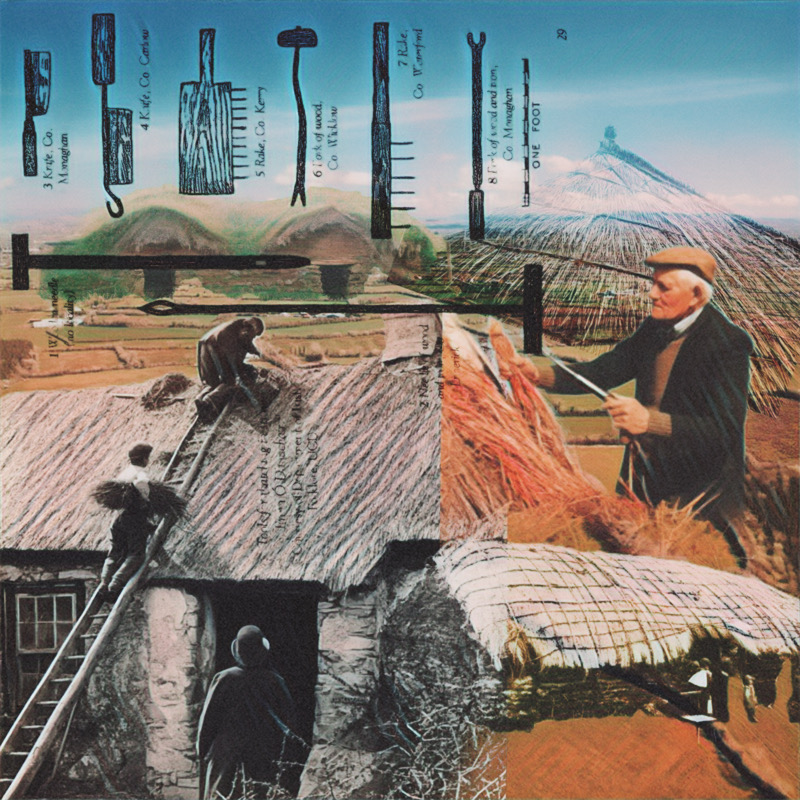
Sod was also often used as an underlayer for thatching, the roof covering most commonly associated with Irish vernacular housing. Thatching material preferences vary by region, but include wheat straw, flax, rye and reeds. Installation methods were also regional and appropriate to environmental factors. Roped thatching along the west coast was held in place by stone-weighted roping, while east coast homes were characterised by thrust thatching, where bundles are sewn in place and secured to roof-timbers. Both of these methods hold up to strong coastal winds and the more complex thrust method may indicate the presence of semi-professional thatchers on the east coast. Pinned thatch is the most common method, found throughout the midlands. This technique combines straight hazel scollops pinned in place by bent lubáns, which act as staples to secure the thatching. The bundles at the apex of the roof are secured by decorative boibíns – bundles of thatch looped around the central timber. Finished roofs may be coated in clay or sprayed with copper solutions for preservation (Ó Danachair 1945). The skill and maintenance required to sustain thatching has contributed to its gradual demise, though the aesthetic is romanticised and associated with Irish identity (Mullane 2019).
The cosmology of the home is reinforced by thatching techniques, which ensure the thickest insulation over the kitchen, the centre of activity and warmth, while less utilised rooms, like the west room are kept cooler (Gailey 1984). Contemporary tensions exist in regard to thatching, which utilises sustainable materials, but needs to be replaced often. There are attempts to preserve the tradition for tradition’s sake, but cost and difficulty obtaining insurance make thatch roofs a luxury and often relegated to outbuildings.
Bibliography
Ballard, Linda M. 1991. “Is It Traditional.” Irish Arts Review Yearbook, no. Journal Article, 223–28.
Gailey, Alan. 1984. Rural Houses of the North of Ireland. Edinburgh: John Donald Publishers Ltd.
Glassie, Henry. 1999. Material Culture. Bloomington, Ind: Indiana University Press.
Mullane, Fidelma. 2019. “Croiceann Cruaidh Féarmhar an Talaimh: A Material Culture of theSkin of the Earth – the Example of Roofing with Sod Parings in Ireland.” Folk Life 57 (1): 1–26. https://doi.org/10.1080/04308778.2019.1592936.
Ó Danachair, Caoimhín. 1945. “The Questionnaire System.” Béaloideas 15 (1/2): 203–17. https://doi.org/10.2307/20522101.
O’Reilly, Barry. 2011. “Hearth and Home: The Vernacular House in Ireland from c. 1800.” Proceedings of the Royal Irish Academy. Section C: Archaeology, Celtic Studies, History, Linguistics, Literature 111C:193–215.
 Bridging Appalachia
Leave a comment