
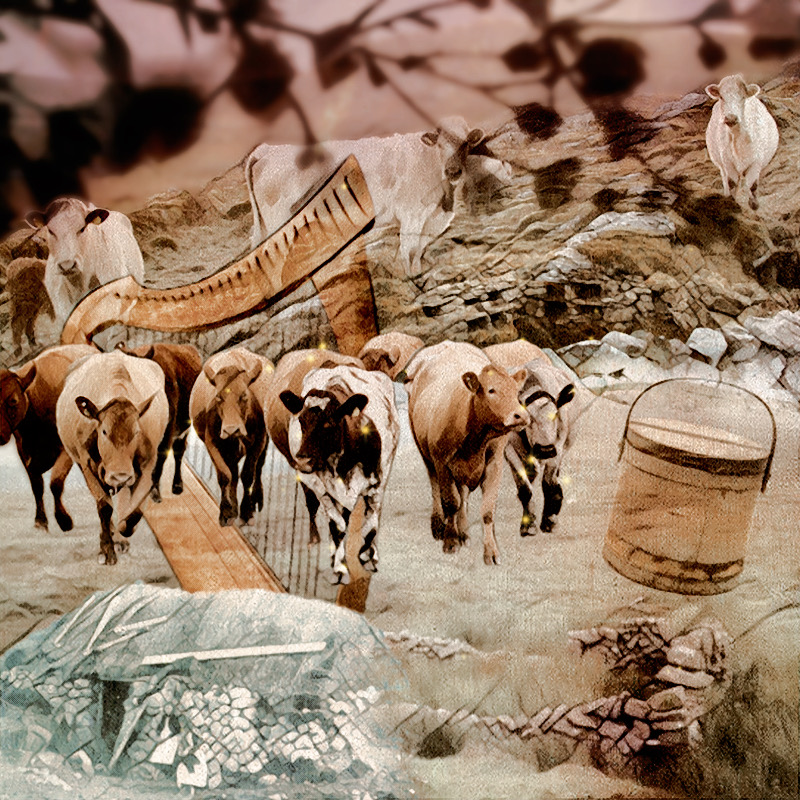
Transhumance “is the seasonal movement of people and livestock from one environmental context to another” and buaile[ing] or the shieling system are forms of “seasonal pastoralism” common in Gaelic countries into the 20th century as a vernacular response to the landscape that in turn informed lifeways and material culture (Costello 2020, 1). In most cases, cattle and tenders travel to marginal land for summer pasturing and return to farmsteads in the winter. This process allows proximal land to be utilised for crops during the growing season, while maintaining the well-being of cattle, who return to manure the fields in the winter (Costello 2020; Evans 1957; Ó Danachair 1983). Specific practices are landscape-dependent. For instance, the Burren, which contains large amounts of heat-storing limestone has cattle moving away during winter months (Winterage, n.d.).
Social aspects of booleying are characterised by gendered divisions of labour, with young girls, in charge of milk and butter production, travelling to summer pastureland and men and boys remaining close to home to tend crops and perform maintenance (Cheape 1996; Ó Danachair 1983). This separation created seasonal rites of passage for girls and provided opportunities for celebratory evening visitations by home-bound boys on Sundays and holidays (Ó Danachair 1983). The seasonal migration required temporary housing, constructed in cooperation with the landscape. These are referred to as shieling in the Outer Hebrides, where turf bricks are roofed with sod and heather, all materials found in the immediate vicinity (Walker 1989). In Connemara, rectangular stone houses were built against large boulders, which provided a large portion of the wall structure (Costello 2020). Milk and butter storage was accommodated through the construction of cool stone alcoves, huts or cellars (Cheape 1996; Ó Danachair 1983).
Milk-production was central to inland economic security and the importance of this human – animal – landscape relationship is evident in the legacy of language, placenames and tales related to transhumance. The cyclical movement between the baile (bally – homeland) and the buaile defines the process. At least 5000 townlands in Ireland begin with Bally, while booley sites contain locally recognised names – Buaile, Bráca, Bothóg, Áirí (Costello 2020). In Scotland, regional terms for shieling – Shiel, Airidh, Ruidh, Setr – are applied to placenames with seasonal grazing areas (Cheape 1996). Tales of killing the last wolf in Ireland were often attributed to marginal buaile land and may indicate coded warnings for young girls working alone in liminal areas of danger (Ó Danachair 1983). The intergenerational knowledge of seasonal pastoralism is incorporated into contemporary regenerative farming methods, which are being employed to restore landscape diversity on lands impacted by colonialism, irresponsible agricultural policies and the loss of apex predators (Duffy 2024).
Bibliography
Ballard, Linda M. 1991. “Is It Traditional.” Irish Arts Review Yearbook, no. Journal Article, 223–28.
Cheape, Hugh. 1996. “Shielings in the Highlands and Islands of Scotland: Prehistory to the Present.” Folk Life 35 (1): 7–24. https://doi.org/10.1179/043087796798254498.
Costello, Eugene. 2020. Transhumance and the Making of Ireland’s Uplands, 1550-1900. Vol. 7. Woodbridge, Suffolk: The Boydell Press is an imprint of Boydell & Brewer Ltd.
Duffy, John. 2024. Informal talk at Future Oak Farm, 11 April, 2024.
Evans, E. Estyn. 2000. “Bally and Booley.” In Irish Folk Ways, 27–38. Newton Abbott; New York; Dover.
Glassie, Henry. 1999. Material Culture. Bloomington, Ind: Indiana University Press.
Ó Danachair, Caoimhín. 1983. “Summer Pasture in Ireland.” Folk Life 22 (1): 36–41. https://doi.org/10.1179/043087783798254591.
Walker, Bruce. 1989. “Edited Notes on Hebridean Buildings from Ake Campbell’s Field Notebooks of July 1948: I – Sheiling Huts.” Edited by Scottish Vernacular Buildings Working Group. Vernacular Building 13:47–51.
“Winterage – Burren Winterage Weekend.” n.d. https://www.burrenwinterage.com/. Accessed May 16, 2024. https://www.burrenwinterage.com/winterage/.
 Bridging Appalachia
Leave a comment