
My blackthorn shillelagh was obtained for the practice of Doyle-style bataireacht, a tradition of two-handed, Irish[1] stick fighting, which was passed through the male lineage of the Doyle family, beginning in the west of Ireland and continuing in the Mi’kmaw territory of Ktaqmkuk[2] after the family’s emigration. With his father’s deathbed permission and a drive to preserve the technique, Glen Doyle brought his family’s fighting style to the public in 1998 (Doyle Irish 2022). My bataireacht lineage passes from Glen Doyle to Bernard Leddy of Leitrim to my coach, Cú McCann of Baltimore, Maryland[3]. Through our Sionnach Aiteach Faction, Cú emphasises community defence and liberatory practices, while centring trans and queer experiences (McCann). My blackthorn stick stands as a tool of play, discipline and resistance, while tying my practice to ancestral land and knowledge, and an embodied legacy of defiance in the face of injustice. This multivalent weapon lends power to the present as I navigate complex queer and diasporic identities and attempt to dismantle both internalised trauma and external systems, which perpetuate colonial legacies and current imperial projects (Alderson 2019). These layers of crystallised meaning are formed through various everyday and celebratory contexts, beginning with shillelagh creation and continuing through communication and consumption (Glassie 1999; Turner 1982).
My shillelagh was constructed by Liam Ó Caidhla and family at Olde Shillelagh Stickmakers in County Wicklow. Liam’s patrilineal crafting tradition traces back to his great-grandfather Denis, who provided regimental canes for officers in the British army. The Ó Caidhla family makes both walking and fighting sticks and furnishes the New York 96th Infantry with ceremonial sticks for the annual Saint Patrick’s Day parade (O’Donoghue 2021; “Shillelagh Sticks”). Olde Shillelagh Stickmakers harvests locally-sourced Blackthorn[4]. Although several native plants[5] can be used, Blackthorn provides strength and flexibility that not only supports functioning, but embodies idealised characteristics of the Irish people. Traditional blackthorn shillelagh creation begins with collecting straight, root-growing sticks, during the time of the year when sap is not rising. The root portion of the stick, when present, provides the larger striking end of the weapon and doubles as a grip when the shillelagh is utilised or camouflaged as a walking stick. The bark is generally left on, sometimes including the thorns, but the ends are cut and smoothed to form the knob and narrow the tip (Hurley 2004; NFC S 204: 262-263).
Historically, the stick was placed in the chimney above a peat fire for many months to eliminate all moisture. After drying, the shillelagh was treated with lard, oil or butter until completely saturated. This process replaced the removed moisture, increasing elasticity and preventing mould. Facilitative heat was added by burying the stick in a dung heap or gently applying fire daily and pressure was used to remove bends. The shillelagh was finished with a coat of black lead, grease or oil. If the stick was not balanced or too light in general, molten lead could be poured into a drilled hole to add weight. Optional iron ferrules and a leather thong could also be added (Hurley 2004; Moraghan 2020; NFC S 204: 262-263). Liam Ó Caidhla shares that “[t]he craft of making perfectly balanced walking and fighting sticks has changed little over the ages,” but new “finishing techniques…allow the sticks to handle hotter climates and modern centrally heated homes” (“Shillelagh Sticks”). His process takes 2-5 years and fighting sticks are seasoned[6] in a way that enhances their balance and accuracy (“Shillelagh Sticks”).
According to Irish martial arts scholar, John Hurley, “Europe[an] weapons seem to have been more influential in shaping martial art, than martial art was in shaping weaponry” (2007, 33). Function dictated by form in this context indicates a sensory connection to landscape, particularly sacred trees, and an inherent idea of how shillelagh fighting was practiced before oral/written records and modern incarnations. The length of the shillelagh is imposed by the height of the individual for which it is constructed. This customisation contributes to a relationship with the stick as an extension of the body. “Vernacular relationships with Blackthorn are ambivalent due to the plant’s conflicting attributes of danger and protection,” stemming from associations with the Otherworld (Sellner 2024). Many archival accounts refer to the hazards related to cutting Blackthorn found near fairy forts, including death or misfortune (NFC S 171: 274; NFC S 677: 117-118). Conversely, blackthorn sticks are known to provide protection against harm, making them a clear choice for both resistance and general defence (MacCoitir 2015). May Day in Ireland is a time for reinforcing boundaries and one archival source refers to “put[ting] a blackthorn stick in the churn for fear the [good people] would take away the butter” (NFC S 157: 186). These conflicting approaches to Blackthorn may indicate a transference of danger from self to foe and/or a cooperative relationship with the Otherworld in defence of the land.
The shillelagh as a fighting stick performs the function of personal and community defence in close combat. The context of such measures has changed over time and space, while retaining the exegetical legacies of each period, including mythic representations, pre-Christian ritual symbolism and shifts in meaning during penal times, the height of faction fighting and the rise of Irish nationalism. The practice of Irish stick fighting as a war game or demonstration of fighting prowess echoes mythologic tales of gods and heroes, who engaged in hurling-type matches or battles as part of their training, warfare or entrance to manhood. In the lead-up to the First Battle of Maigh Tuireadh, the impetuous young warriors of the Tuatha Dé Dannan and the Fir Bolg engage in a fatal scoobeen[7], or “ritualistic battle” (Hurley 2007, 87). Lúgh was later purported to establish a fair with competitive games in County Meath, which continued among mortals for hundreds of years (Hurley 2007). Mythical antihero, Cú Chulainn received his name after defeating a vicious hound with a cáman[8] and a young Fionn Mac Cumhaill defeats a group of boys in hurling to prove his authority over them (NFC S 0139: 38-39; Hurley 2007). The cámain, used in proto-iterations of hurling-type games, would have closely resembled a shillelagh with a large root knob or bend at one end. There are direct correlations between the modern ash cáman in hurling and the blackthorn shillelagh, which are demonstrated by shared legacies (Hurley 2007).
Folk stories of fairy matches are also common. MacNéill documents several accounts of battles or matches between fairy groups or amongst fairies and humans, which could contribute to the success of a year’s harvest through sympathetic magic (1962). An archival narrative from County Limerick tells of a man who suffers a fairy stroke when passing a lios[9] When he comes back to himself, he sees thirty men in a hurling match, who he recognises as deceased friends (NFC S 514: 195). Brehon Law recognised sites for ritual battles at revered locations and “these matches …were part of a larger social and cultural fabric, which infused and united Irish society” as they mirrored Otherworld battles and imbued stick weapons with ancestral supernatural power (Hurley 2007, 88). In pre-Christian and early Christian Ireland, these matches followed the agrarian calendar by marking seasonal changes during festivals, “which “regulate[d] order between the mortal and spiritual worlds (Hurley 2007, 82). They also became funerary games, enjoyed at wakes (Hurley 2007). These practices are enacted representations of myth through ritual and interaction with the landscape.
Traditionally, shillelagh construction and training were intergenerational knowledge, with young boys creating their own weapon under the guidance of a relative or hedge-master. This rite of passage emphasised community values of pride and protection, which would shift to resistance in the Penal era as people fought to uphold Irish identity and tradition (Hurley 2007). As material culture, the blackthorn shillelagh is always in becoming, shifting in meaning through a combination of ordinary and ritual contexts, layered with personal and community beliefs. The time, commitment and mentorship involved in its creation imbued both the creator and the stick weapon with stories of past, present and future. In hedge-schools, this might include a history of warrior culture, an act of everyday resistance and a vision of agency and self-determination. Hedge-schools were so called due to their clandestine locations in barns or behind hedges, bringing the students in frequent contact with Blackthorn and emphasising the plant’s protective nature. In County Kerry, students made ink from Blackthorn sloes at a school under two bushes and in County Longford, a surreptitious school was sheltered by a thorny Blackthorn hedge (NFC S 405: 625-626; NFC S 757: 288). “The function of these impenetrable hedges sits in contradiction as they straddle the line between thresholds of protection or oppression, depending on position. During An Gorta Mór, starving citizens were barricaded from the English-owned farms they once inhabited, yet they foraged meagre sustenance, including bitter sloes, from the very borders that forbade them” and extracted thorny weapons of resistance from the protective walls of their hidden schools (Sellner 2024).
There are many types of Irish stick weapons. The term sail éille, one potential origin for shillelagh, would have originally referred to a four-foot, knobless, lead-filled stick with an iron ferule at each end. The eventual use of shillelagh as a catchall term for stick weapons and its association with three-foot, knobbed weapons/walking sticks may emerge from another potential source. During Penal times, when Catholics were forbidden weapons, many people carried so-called walking sticks or bata siúil éille, which functioned as apparent mobility aids, while providing immediate access to a stealth weapon (Hurley 2004; Moraghan 2020). Carrying one of these sticks communicated an act of resistance by a colonised people, which was distorted by the English through bigoted descriptions of drunk stick-wielding leprechauns in an effort to dehumanise the Irish and encourage self-policing of defiant behaviour. A distillation of this stereotype was eventually sold as an industrially produced, decorative and hammer-like tourist “shillelagh.” According to Danaher, “the modern tourist shillelagh is not actually a shillelagh at all and does not have a native Irish origin” (Hurley 2007, 119). He differentiates this from the traditional weapon, which tourists will also purchase as a blackthorn walking stick. Although the mass-produced “shillelagh” is an affront to Irish heritage, this association contributes to the term’s survival in collective memory.
Most documentation and scholarship of shillelagh communication and consumption through Irish stick fighting centres on the collaborative performance of faction fighting. These confrontations have roots in land disputes among Irish nobles and the men loyal to them, who engaged in both single-combat duels and larger battles. Legacies of clan resentments were passed through generations, even when the original cause had faded from memory (Hurley 2007; Moraghan 2020). Initially, these challenges were guided by hereditary Shillelagh Law an honourable code of behaviour that promoted an emic view of fighting as a proud demonstration of skill and fairness. This shared system of values equated winning with bravery and good character, while challenging etic stereotypes of the Irish as lovers of gratuitous brawling. The protocols insisted on support for the underdog and forbade the striking of women, regardless of provocation (Hurley 2007). They also required fights to be evenly matched in both number and weaponry, reflecting the ideological negotiations of Bres and Sreng before the mythic Battle of Maigh Tuireadh (Hurley 2007; Colcombe 2008). The performance of faction fighting often followed a script that has been preserved in art and literature. Fights were generally held at celebratory events, such as fairs and were preceded by drinking, dancing and music. Enveloped by this communal dissolution of societal boundaries, a ritual battle would emerge, perhaps beginning with insults exchanged between two men. Fighters from opposing factions would line up at opposite ends of the field of play, while women and children pressed in to get a good view. The tension of anticipation may have been broken by an old woman[10] or priest, who would loudly condemn the oncoming fight. While these disruptions were potentially performative, they represented an institutional demand for order, with the Catholic Church condemning the recreational activities, which accompanied these challenges and resenting their tendency to take place on Sundays or Pattern Days (Hurley 2007).
A period of psychological warfare was enacted through wheeling, where a single man challenged his opposition through insults, brandishing of his shillelagh and/or ceremoniously dragging his long coat across the ground and daring someone to step on it, thus providing umbrage enough for a fight. The other men might rile up the crowd by yelling and flourishing their weapons. Eventually a contender would step forward to rebuff the wheeler. This one-on-one combat would provide the spark for a group melee, which would proceed until there was a need to regroup and enter a phalanx formation. At this point, women could engage in the fight by throwing rocks or swinging them in hastily removed stockings. A woman’s loyalty could go against her husband if her father or brothers fought on the opposing side, however, marriage to a woman associated with a strong faction could provide rare financial opportunity. Women also played a large role in the aftermath of the fighting by providing care to the wounded before all rejoined the celebration and animosity was temporarily forgotten (Hurley 2007; NFC S 539: 240-242).
During this cultural performance, the shillelagh shifts from a symbol of protection, agency and resistance to a physical enactment of warrior prowess that connects the fighter’s body to the landscape through material and myth. The combatant enacts his operational knowledge of the weight and length of his weapon in harmony with ancestral embodiment of martial movement that has been adapted and expanded through generations. He superimposes Otherworldly battles upon the societal tensions of his current context, while adhering to the same set of value-based rules that have been passed down to maintain collective unity through physical catharsis (Upton 2015). An account from County Limerick emphasises the voracity of faction fights, while capturing their relationship to mythic values –
“Seamus Mór Harnett…took down a shillelagh from over the hob where it had been seasoning for some years…with such energy and determination did he proceed on his journey to Abbeyfeale that the muscles of his legs expanded…[and]…the brass buttons in the knees of his breeches…flew off with such terrific force that they broke the windows in the houses of Knockbrac, at least half a mile across the fields from the main road” (NFC S 491: 131-132).
This fantastic description of a dedicated human fighter reflects the bodily transformations or ríastrad experienced by battling demi-god Cú Chulainn (Dunn 1914). Fighting rituals, which settled disputes and promoted social cohesion through the breakdown and reestablishment of societal norms, began to devolve into vicious free-for-alls as factions grew in power and Shillelagh Law became less dominate in the collective psyche (Hurley 2007; Moraghan 2020).
This breakdown is intimately tied to the ravages of colonisation and the internalisation of harmful stereotypes perpetuated by the colonisers. Irish stick fighting, once a practice of pride and resistance used to reinforce local identity, connection with the landscape and, later, retaliation against oppressive landlords, became associated with shame and poverty. Forced assimilation was achieved through imposed starvation, during An Gorta Mór and the resulting mass emigration. Xenophobic characterisations of Irish fighters were reinforced by anti-immigration propaganda in the United States where limited resources and generational grudges led to violent street battles that lacked the guidance of Shillelagh Law (Hurley 2007). In the wake of the great hunger, the remaining Catholic population of Ireland rejected both Irish language and faction fighting to ensure the survival of future generations. Anti-faction sentiments were encouraged by the Irish Nationalist movement, who pressured faction leaders to unite under the common banner of Irish independence, while adapting earlier combat styles to gunfighting and military strategies. Post-independence, there was a concerted effort to redefine “Irishness” through a decisive promotion and suppression of various traditions. The memory of Irish stick fighting as a demonstration of honour was nearly lost in the public consciousness, though the elevation of hurling did carry some of the multivocal story to the present day (Hurley 2007).
Though the polysemous nature of the shillelagh has been obscured by a complicated history of colonisation and subsequent societal rejection, it embodies an ancestral value system, a connection with the landscape, a resistance to oppression and the resilient nature of the Irish people. Large swaths of the population have been vocal in demanding freedom for Palestine. A shared history of occupation and forced starvation drives this solidarity, as may remnants of Shillelagh Law, which promoted fairness and justice. Though these ideals were supressed by the English and the Catholic Church, they were not fully extinguished. Their endurance is voiced by every Blackthorn hedgerow that criss-crosses the land and by the continued practice of Doyle-style bataireacht, which was sustained by tradition-bearers in the diaspora before reintroduction to its land of origin. This cultural inoculation has led to the development of new styles of stick fighting that have the potential to convey contemporary ideals rooted in ancestral practices, which are intimately tied to the land. As climate-related changes increasingly threaten both people and the landscape, opportunities for land connection are vital.
In addition to the institutional elevation of hurling as an exegetical signpost of Irishness, aspects of shillelagh folkways have been officially and unofficially suppressed or maintained through contemporary performance and exhibition (Cashman 2006). Ritual battle is particularly associated with Lughnasa in recognition of Lúgh’s establishment of fairs with sacred games. Many traditions surrounding Lúgh were appropriated by the church in the name of Saint Patrick; however, there are a few celebrations that continue with fighting omitted. Although the National Museum of Ireland holds several shillelaghs, they do not publicly display them. They are digitally catalogued with little detail, but do often list the original owners. Failing to exhibit this material culture in relation to other items and/or biographical information, deprives the public of narrative contexts that aid in parsing their multivocal expressions. The museum does archive two political cartoons, which present shillelaghs alongside nationalist values. Figure one depicts an Irish Catholic man’s right to vote as “the real shillelagh,” simultaneously minimising and valorising the stick weapon (Political Cartoon 1883; “The Franchise” 2024). The second figure portrays the institutional suppression of the press after they publish liberal Prime Minister William Gladstone’s suggestion of “blackthorns against batons if the people are illegally assailed” (Reigh 1890).
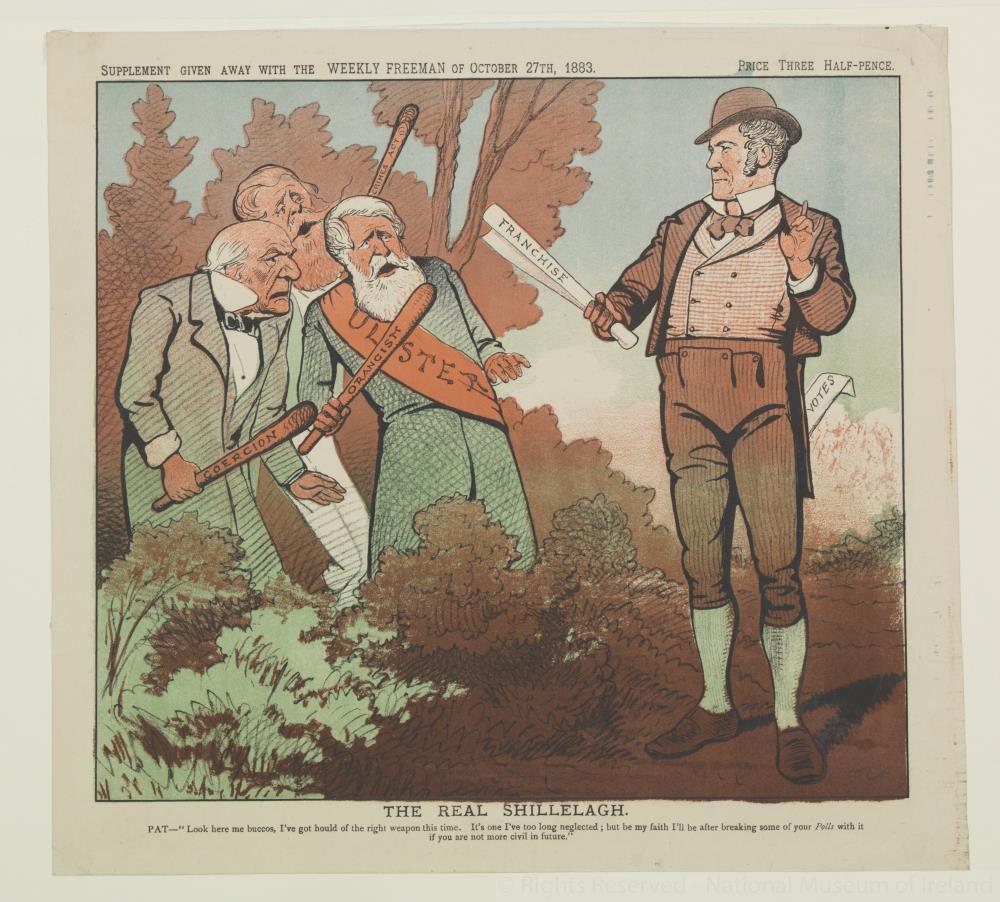
Figure 1 – “Supplement from the Weekly Freeman, 27 October 1883. Titled ‘The Real Shillelagh’. Depicting an Irishman with the franchise confronting three Orangemen” (Political Cartoon 1883).

Figure 2 – “Supplement to the United Ireland, 9 August 1890. Titled ‘The Whipping Boy’. Colour print in red, black and blue – one half shows Gladstone speaking at Hawarden; ‘Why not blackthorns against batons if the people are illegally assailed’. The other show T. Walsh, editor and proprietor of the Cashel Sentinel being flogged by a Removables Half Pay Officer Waring, and Policeman Irwin for reporting Mr. Gladstone’s Statement – ‘Why not blackthorns against batons, if the people are illegally assaulted’. Over his head hangs the notice ‘Coercion Court’” (Reigh 1890).
Hurley’s comprehensive work on Irish stick fighting draws on many literary and archival sources, which demonstrate some of the contradictions inherent in the folklife of the shillelagh, as they are presented by upper class authors with a disorienting mixture of appreciation and condemnation. Archival sources from the National Folklore Collection are often dependent on recollections of later faction fights, which are affected by negative associations, however, there are echoes of nostalgia for earlier connotations. The reclamation of Irish stick fighting as a reconnection to land, ancestral memory or resistance requires gleaning semiotics from myriad sources along with an intuitive reimagining of the practice as it relates to embodied memory, intersectional identities and contemporary problems.
My own bataireacht practice instils values of commitment, belonging and collective liberation. My blackthorn shillelagh transforms from an everyday motility aid to an extension of my disabled body that provides transmobility[11] in heightened situations of ritual or actual battle. It is imbued with protection for myself and my community, a continuation of ancestral tradition and a re-presentation of play that is queered by femme interpretations of patriarchal gender norms and globalised by a recognition of liberation that extends beyond borders, its portability and crystalised multivocality allowing for travel across both time and space. As I reflect on the preservation of Doyle-style bataireacht, I wonder what other threads of this native practice might still be unearthed.
Bibliography
Alderson, Aedan. 2019. “Decolonizing the Irish: The International Resistance and Entrenchment of the Global Irish Diaspora.” Studi Irlandesi 9 (9): 365. https://doi.org/10.13128/SIJIS-2239-3978-25580.
Cashman, Ray. 2006. “Critical Nostalgia and Material Culture in Northern Ireland.” The Journal of American Folklore 119 (472): 137–60. https://doi.org/10.1353/jaf.2006.0016.
Colcombe, Gary, and Ruth Colcombe. 2008. “Gods in the Mist.” Celtic Myth Podshow. https://celticmythshow.libsyn.com/size/5/?search=cmp001.
“Doyle Irish Stick Fighting.” 2022 Doyle Site. Accessed July 9, 2024. https://www.doyleirishstick.com.
Dunn, Joseph trans. 1914. English As We Speak It in Ireland. London: David Nuitt. 2005 Project Gutenberg. Accessed July 16, 2024. https://www.gutenberg.org/files/16464/16464-h/16464-h.htm
Glassie, Henry. 1999. Material Culture. Bloomington, Ind: Indiana University Press.
Hurley, John. 2004. The Shillelagh Makers Handbook. West Long Branch, NJ: Caravat Press.
Hurley, John. 2007. Shillelagh: The Irish Fighting Stick. Pipersville, PA: Caravat Press.
Joyce. P. W. 1910. English As We Speak It in Ireland. Dublin: M. H. Gill & Son, LTD. 2010 Project Gutenberg. Accessed July 12, 2024. https://www.gutenberg.org/files/34251/34251-h/34251-h.htm.
MacCoitir, Niall, and Grania Langrishe. 2015. Ireland’s Trees: Myths, Legends and Folklore. Cork: The Collins Press.
MacNéill, Máire and Irish Folklore Commission. 1962. The Festival of Lughnasa: A Study of the Survival of the Celtic Festival of the Beginning of Harvest. London: Oxford U. P.
McCann, Cú. n.d. “Our School.” Strange Fox Fighting Arts. Accessed May 30, 2024. https://www.strangefoxfightingarts.com/aboutus.
Moraghan, Sean. 2020. Days of the Blackthorn: Faction Fighters of Kerry. Cork: Mercier Press.
Nelson, M. K., Shew, A., & Stevens, B. (2019). “Transmobility: Rethinking the possibilities in cyborg (cripborg) bodies.” Catalyst: Feminism, Theory, Technoscience 5(1): 1-20.
NFC S 157: 186. Mr Joseph Devins, County Sligo. Collector: Kathleen Devins, Log na nGall Scoil, County Sligo. Teachers: Tomás Ó Hodhráin and Bean Uí Hodhráin.
NFC S 171: 274. Mrs. Jinks, County Sligo. Collector: Tobar an Choire Scoil, County Sligo, 1938. Teacher: Eilís Caswall.
NFC S 204: 262-263. Francis Mc Loughlin (55), carpenter, County Leitrim. Collector: Tessie Mc Loughlin, Kilmore School, County Leitrim, 1937-39. Teacher: Eilís, Bean Uí Cheallaigh.
NFC S 491: 131-132. Collector: Monagea (B.), Newcastlewest School, County Limerick, 1938. Teacher: John Ahern.
NFC S 514: 195. Collector: Bridie Stanton, Coill Beithne (C.), Baile Mhistéala Scoil, County Limerick, 1936.
NFC S 539: 240-242. Michael Coffey (32), labourer, Annaholty County Tipperary. Collector: Teresa Browne, Tulach Sheasta, Clochair na Trócaire Scoil, County Tipperary, 1938. Teacher: Sr Bertrand.
NFC S 677: 117-118. Mrs Emerson, County Louth. Collector: Collon School, County Louth, 1937-38. Teacher: E. Ní Earchadha.
O’Donoghue, Anne. 2021. “My Country Living: Shillelagh Making in Co Wicklow.” Irish Farmer’s Journal, July 14, 2021. https://www.farmersjournal.ie/life/features/my-country-living-shillelagh-making-in-co-wicklow-633796.
“Political Cartoon / The Real Shillelagh, 1883.” n.d. National Museum of Ireland. Accessed May 24, 2024. https://collections.museum.ie/en-IE/Collections-Research.
Reigh, J.D. “Political Cartoon / The Whipping Boy, 1890.” n.d. National Museum of Ireland. Accessed May 24, 2024. https://collections.museum.ie/en-IE/Collections-Research.
Sellner, Jess Erin. 2024. “Relationships with Blackthorn in Irish Folk Medical Tradition.” Unpublished paper, School of Irish, Celtic Studies and Folklore, University College Dublin.
“Shillelagh Sticks.” n.d. Olde Shillelagh. Accessed May 24, 2024. https://www.oldeshillelagh.com.
“The Franchise – Irish Legal Blog.” 2024. Accessed May 24, 2024. https://legalblog.ie/the-franchise/.
Turner, Victor, ed. 1982. “Introduction.” In Celebration: Studies in Festivity and Ritual, 11–30. Washington D.C.: Smithsonian Institution Press.
Upton, Brian. 2015. The Aesthetic of Play. 1st ed. Cambridge, Massachusetts: The MIT Press. https://doi.org/10.7551/mitpress/9251.001.0001.
[1] The term Irish will be used to identify people and traditions rooted in the island of Éire (and its associated islands, although this broad self-identification may not have been common until the period of Irish nationalism. Prior self-identification would have been more diverse and localized.
[2] Newfoundland
[3] Piscataway land
[4] Blackthorn is capitalized when referencing the animate plant-being, as contrasted with the inanimate stick.
[5] Oak, Crab-tree, Hazel, Ash, Hickory, Willow or Hawthorn
[6] dried
[7] “Conquering goal;” large match involving two competing districts over a large area as opposed to a pitch with small teams (Hurley 2007; Joyce 1910)
[8] Hurling stick
[9] Fairy fort
[10] Cailleach figure
[11] “The idea that disabled bodies actually have a greater array of options for mobility and movement, providing an impetus for creativity and imagination” (Nelson et al. 2019, 2).

 Bridging Appalachia
Leave a reply to Blackthorn Relationships in Fairy Faith – Bridging Appalachia Cancel reply